

An article by Derek Thompson from The Atlantic went viral recently for sharing some stark numbers. In the last 30 years, Americans have seen double-digit declines in practically every measure of socializing, from attending a sporting event to working on a community project. The biggest change has happened in the number of people hosting at home at least once per month, which has decreased by 71%, from 42% in 1975 to 12% in 2026.
He attributes several reasons for why people stopped hosting, but essentially argues that it’s because it can feel too hard, when other options seem so easy. He writes: “Compared to TikTok, a dinner party is a terrible leisure technology. It requires matching schedules, cleaning the house, buying food, accommodating children and allergies, tolerating awkwardness, and taking the risk that the evening is mediocre. By contrast, what does television ask of us? Nothing. TikTok? Even less.”
The thing is, people do want connection. They want to build meaningful friendships and to feel like they belong to their neighborhood. And despite how easy it might be to find distraction with digital alternatives, there is a reason why so many of us use words like “brain rot” and “doomscrolling” to refer to our time spent there.
We have a different theory than Thompson. For many folks, all that is missing is an invitation. And it doesn’t need to be too complicated. It can start with a piece of paper inviting your neighbors in.
A while ago, we talked with a friend who runs a community program in Colorado Springs. She told us about how when she moved to her neighborhood, she didn’t know a single person for the first six months. She started reaching out slowly to folks, organizing events with neighbors. But the thing that really made a difference was a flyer.
She did a simple design with an invitation to a cornhole tournament. She went door to door, placing it on her neighbors’ doorknobs or giving it to them directly. There wasn’t much to it. It was a simple invitation with no expectation other than telling “I live near you, and I’d like to know you.”
She says it worked wonderfully. Dozens of families came to the event.
We haven’t stopped thinking about that story because maybe it is as simple as sharing a piece of paper. Screens can hold your attention, but a flyer on your own door, that you can hold and touch, feels different. It feels more special because you discovered something in the real world or someone took the time to walk up and reach out to you. You notice it because it’s right there, in the place you already are, from someone who is clearly close by. It’s something that we’ve lost with social media.
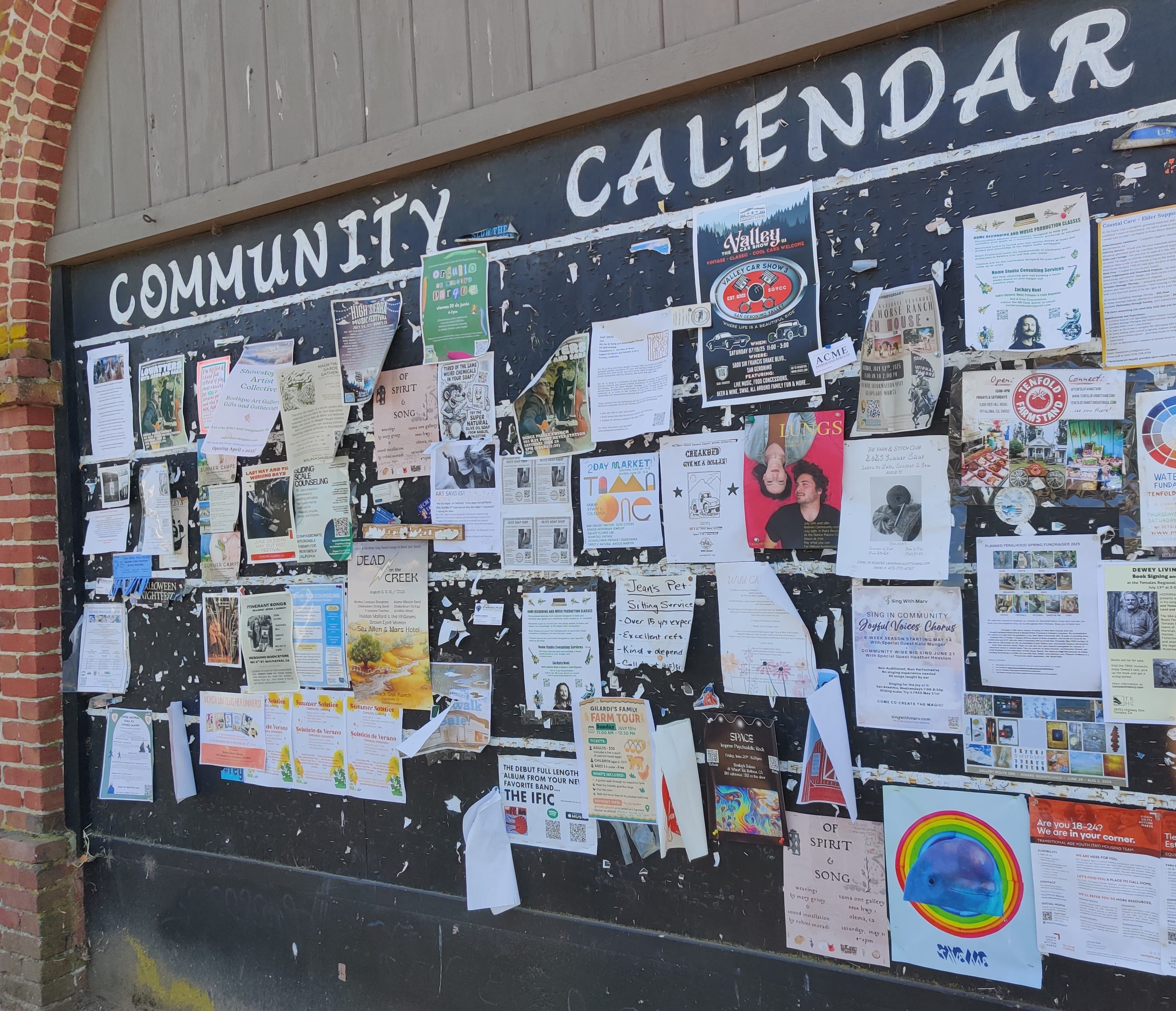
A community calendar in Point Reyes, CA.
We wanted to bring some of that magic to Plurality. When you create an event with us, you can now print a flyer for it. We hope it’s something you’ll want to take outside: tape it to a lamppost, pin it to the community board in the library, or slip it under a few doors on your street.
We built it because we don’t want to be an app that pulls you away from where you are. We want to support the real, slightly messy, hands-on work of getting to know the people around you. Technology can be great at connecting people, but only if it sends you back out into the world rather than keeping you in it.
If you’ve ever felt like you can’t change much about the place you live, we get it. But we’ve seen that it often starts small, often with a printed flyer. A neighbor stops to read it, and maybe they come. Then someone brings a friend. After that, the block feels a little more like yours.
So the next time you create an event, don’t leave it on the screen. Print the poster and share it outside. Put it where your neighbors will see it and let them in.
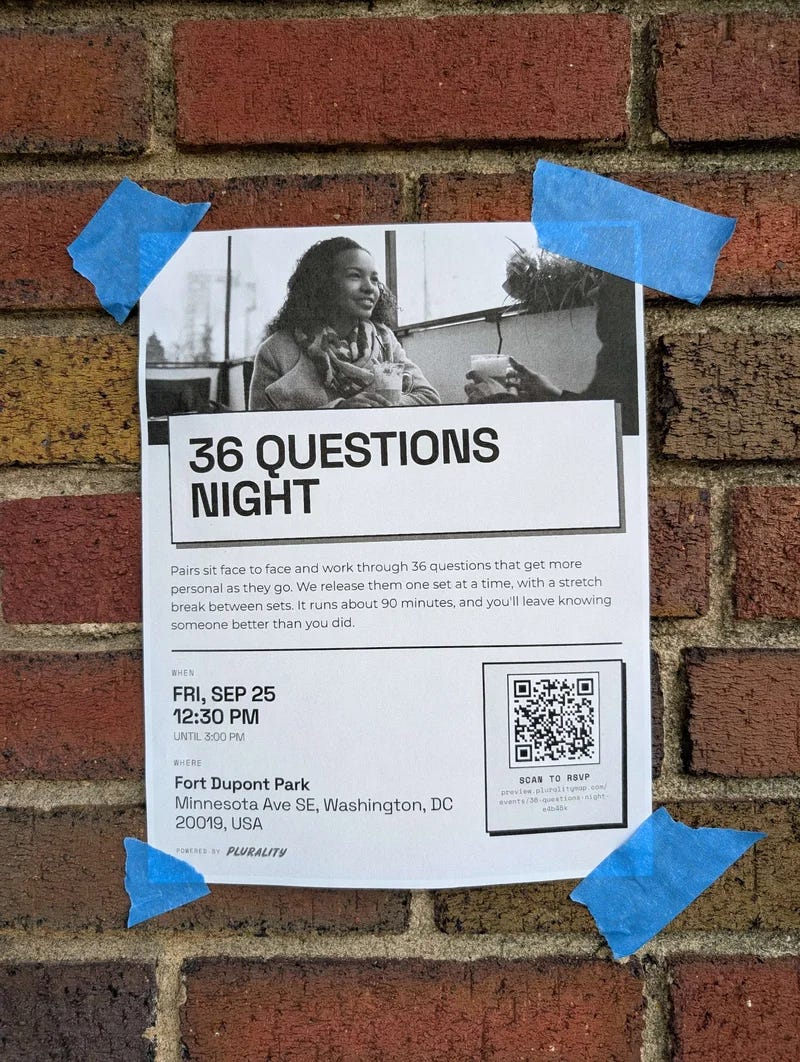
A printable flyer is generated automatically after you create your event in Plurality.