

I met Libby Modern about a year ago on a Zoom call. Two separate folks had asked that I interview her for a newsletter about community builders that I edited at the time. I soon understood why. About five minutes after we started talking, our conversation turned into peepholes.
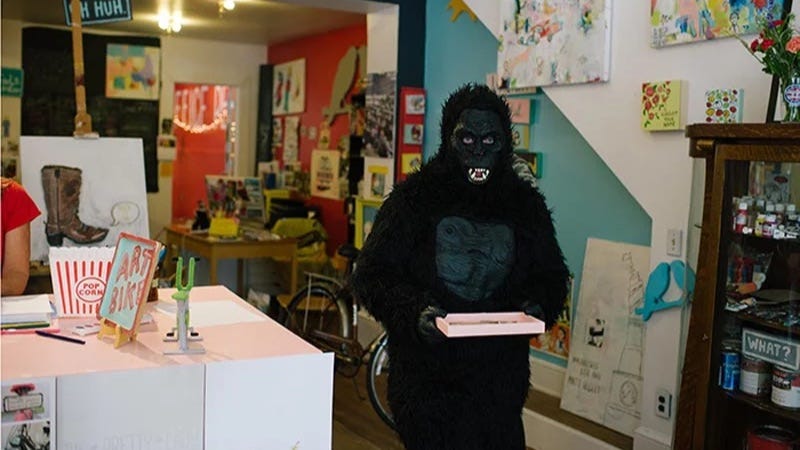
Photo credit: Sara Code Kroll
She told me about one she had been running for several years now out of her art studio in Lancaster, PA. For a month every year, she decorates the front window that looks into North Pine Street with colorful paper and leaves only a small peephole uncovered with an invitation for folks to look inside.
When you do, you’ll find a different neighbor each day doing some form of art. They might be playing the violin, performing a monologue from their favorite play, or cooking a family recipe. Neighbors sign-up and can do whatever they want in the space with a few guidelines to keep it clean and neighborly. She calls it the Art Peep Show and has become a beloved annual tradition.
It all started as an experiment to get neighbors talking and learning about each other, Libby says. “A lot of people when they are out in the world feel isolated and don’t feel comfortable starting a conversation or engaging with someone, even if they are their next-door neighbor,” she says. “The whole idea is to get people to start conversations, so that as you walk by a neighbor you can stop them and say, ‘I saw you at the Art Peep Show!’”
The Art Peep Show is only one of the many other creative projects that Libby is doing to bring neighbors together in her city. All of them share a similar trait: they start from an unexpected place and give you a new reason to start a conversation or deepen a relationship with one of your neighbors.
Another one of my favorites, Truth or Drawer, is a game you can play in one evening. If you pick Truth, a person in a gorilla suit walks to you with a silver tray carrying a postcard with a truth about life like: “In spite of your interior self, people will make judgments based on your appearance.” You sit down, contemplate it, and hold on to the card for the rest of the evening. Libby says that folks naturally start having conversations with others about their own card or another they heard. If instead you pick Drawer, you walk to an old library card catalogue and pull on one of the drawers. Inside, you’ll find a challenge of kindness, like writing a postcard to a neighbor you don’t know or drawing a portrait of a friend.
After listening to all of these amazingly creative projects I was left with two questions: 1) how does Libby come up with such brilliant ideas? 2) What would folks need to replicate them in their own communities?
Adam and I have been noodling a lot with the second question. It’s been at the center of why we built Plurality in the first place. We know most folks are looking for connection and belonging, and want to do something meaningful to address needs in their communities. Even in our heated political environment, according to the Connection Opportunity survey, 74% of Americans are willing to work across all forms of divides (religious, socioeconomic, political, and racial) to tackle a shared goal with their neighbors.
But we also see the opposite happening. It feels like less folks are actually showing up for each other in their communities. Social clubs and other social institutions where we used to connect are disappearing. According to Pew Research Center, we are now more likely to see our neighbors as immoral and lacking ethics than the opposite, the highest percentage of 25 nations surveyed. And 63% of Americans have never taken action with neighbors and 72% only leave their house to get together with people they care about twice or less a month.
We started Plurality to help bridge that gap. We are actively listening to folks to figure out what blocks them from starting something new where they live, what they need to grow an existing initiative, and what they need to make it more sustainable in the long term.
One of the main barriers we’ve heard is that life gets busy and folks don’t have the bandwidth to come up with something new and fun to try with friends and neighbors. They might have a free evening once every other month, but not more than that. And that is where our Blueprints come in.
Blueprints are event templates of tried and tested ideas to bring neighbors together from people all over the world. You browse a few tiles with titles and a small description, get a short story about a great idea, with clear instructions on what you need to do, and an easy format that will help you organize an event within minutes.
The main goal of the Blueprints is to give folks agency to start building community. We take care of some of the work and give you the tools to get started, but you are leading the charge. When you set an event based on Blueprint, we invite you to adapt it however you see fit. And the Blueprint creator can even learn from your innovations, so the ideas keep evolving.
There are three Blueprints created by Libby Modern in the platform, out of 30 currently available in the library. Most come from stories that were in the public domain. A few are from projects that had a ton of impact in their time, but the organization that started it has ceased to exist, and we honor their legacy with the Blueprint.
For Libby, the reason she created the Blueprints in Plurality is simple: it helped her reach more people faster and more efficiently. “People contact me a lot and say, ‘Hey, we want to do this project here.’ And I’m so happy. But then I give all this time to them, telling them how to do it, which I’m happy to do. But if I were doing that all the time, it’s just not sustainable. It would be so nice to just say, go to Plurality,” she says. “And I’d love to see new ideas from other creatives and learn from them. To have a clearinghouse where everything is would be amazing.”